Trent Bridge Pitch Report: ODI, Test & T20 Records Explained (2026 Guide)
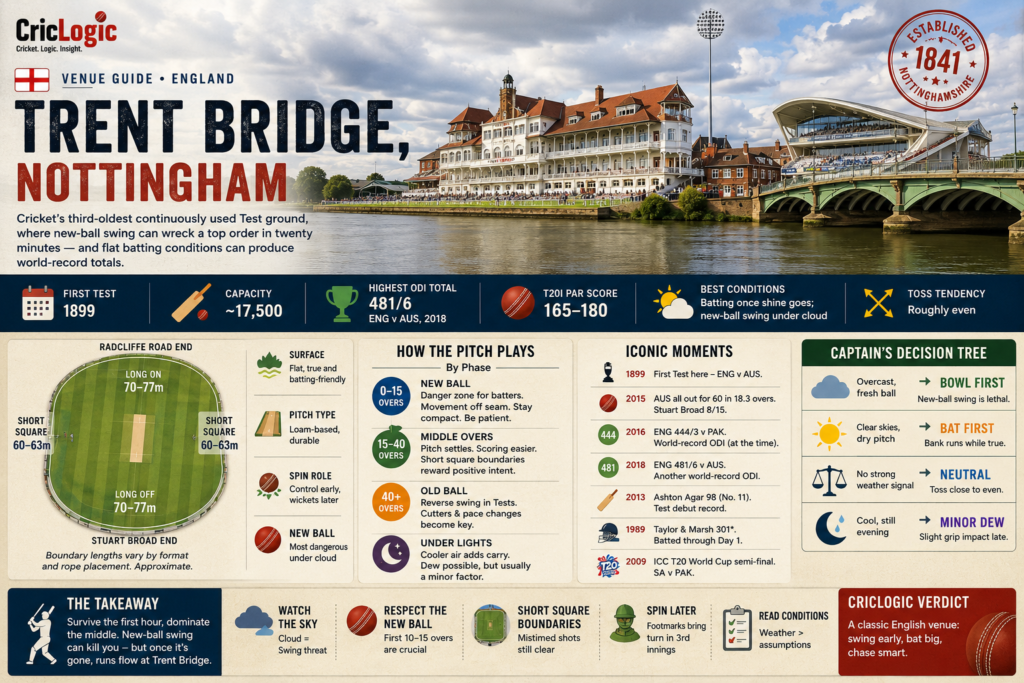
Trent Bridge, Nottingham
Cricket’s third-oldest continuously used Test ground, wedged between the River Trent and a Victorian pavilion that’s currently mid-rebuild — and still one of the most reliable places in England to watch a total get chased down, or a new ball go through the top order in twenty minutes.
TL;DR — Directional Read
Aggregated from historical scorecards, not a live Statsguru pull. Treat as a starting point, not gospel.
- Best conditions forBatting once shine goes; new-ball swing under cloud
- Toss tendencyRoughly even; slight lean to bowl first in Tests, chase in ODIs
- T20I par score~165–180
- ODI par score~250–280 (1st innings)
- Highest ODI total here481/6 (Eng v Aus, 2018)
- Best batting windowMid-innings, once the ball loses hardness
- Biggest risk factorOvercast-sky new-ball collapse (see: Aus 60 all out, 2015)
- Spin roleControl bowling early, wicket-taking role once footmarks form
Stadium Fact Box
- Full name
- Trent Bridge Cricket Ground
- Location
- West Bridgford, Nottinghamshire — across the River Trent from Nottingham city centre
- Home team
- Nottinghamshire County Cricket Club
- Capacity
- ~17,500 (increased from 15,358 in a 2007–08 redevelopment); the Members’ Pavilion itself is being rebuilt with completion due in summer 2026
- Ends
- Stuart Broad End (renamed from the Pavilion End in 2024) and Radcliffe Road End
- First international match
- 1899 (Test, England v Australia)
- First Test
- 1899
- First ODI
- 1974 (England v Pakistan)
- First T20I
- 2009 (Bangladesh v India, ICC World Twenty20)
- Floodlights
- Yes
- Surface
- Flat, generally batting-friendly; some grip for spin as the match wears on
- Boundary length
- Sources disagree — figures range from roughly 60–63 m on the shorter, square sides to 70–77 m down the straight. Treat any single number as approximate; it also shifts a little year to year with rope placement.
Stadium Overview
Trent Bridge is the home of Nottinghamshire County Cricket Club, sitting in West Bridgford on the south bank of the River Trent, a short walk from Nottingham’s city centre and from the football grounds of Nottingham Forest and Notts County. The first recorded match on the site was played behind the Trent Bridge Inn in 1838, and the ground itself was formally opened in 1841 by William Clarke — captain of the All-England XI — on land connected to his wife’s pub. That publican origin story is part of why the ground still feels more like a cricket club than a stadium, even after multiple redevelopments.
What makes Trent Bridge unusual among England’s Test venues is the coexistence of two very different eras in the same footprint. The Members’ Pavilion, a Grade II listed building dating to 1889, still anchors the ground architecturally even mid-rebuild, while the Fox Road Stand — opened in 2002 with an angular, aircraft-wing roof — represents the ground’s more modern, award-winning end. Between them sit the William Clarke Stand, the Smith Cooper Stand (built 2007–08 to replace the old Parr Stand, renamed in 2016), the Radcliffe Road Stand and the Hound Road Stand.
Trent Bridge hosted its first Test in 1899, has been an Ashes venue ever since, and is the ground where England’s men set two separate ODI world-record totals within two years of each other (444/3 in 2016, then 481/6 in 2018 — both against different opponents, both since surpassed at other grounds).
Ground Dimensions and Pitch Construction
Trent Bridge’s outfield is short on the square sides and considerably longer down the ground — but exactly how short depends on which source you check. Fan-facing pitch reports commonly cite roughly 60–63 m square boundaries against 70–77 m straight ones; official broadcast graphics have quoted slightly different combinations from match to match, since the rope is repositioned depending on format and any temporary seating. The practical takeaway for a bowler or captain is more useful than the exact metre count: this is a ground where a mistimed pull or sweep can still clear the rope, so bowling a fuller, straighter line carries less risk than dragging it short and wide.
The square itself is a traditional English loam-based construction, relaid and rolled between matches by the Nottinghamshire groundstaff. Like most county headquarters, it’s prepared to be genuinely flat and true rather than deliberately raked for turn — the surface is engineered for durability across a full Championship and Test season, not for producing a result inside three days.
Venue Statistics
Numbers below are as last compiled from ESPNcricinfo ground records; totals for matches played and averages will keep moving as fixtures are added, so treat exact counts as approximate rather than live.
Test matches — leading run scorers & wicket-takers
| Batting | Runs | Bowling | Wickets |
|---|---|---|---|
| Mike Atherton | 1,083 | James Anderson | 60 |
| Denis Compton | 955 | Alec Bedser | 41 |
| Graham Gooch | 936 | Stuart Broad | 37 |
One-Day Internationals
| Batting | Runs | Bowling | Wickets |
|---|---|---|---|
| Eoin Morgan | 471 | James Anderson | 16 |
| Alex Hales | 441 | Stuart Broad | 14 |
| Jos Buttler | 439 | Waqar Younis | 12 |
Trent Bridge has hosted somewhere in the region of 50 ODIs (different tallies land between the high-40s and mid-50s depending on how abandoned games are counted). One frequently cited split has teams batting first winning 22 and teams batting second winning 25, with the rest tied or no-result — close enough to call it balanced rather than a genuine first-innings or chasing venue. First-innings ODI averages quoted across different samples range from around 250 up toward 280, which is a wide enough band that a single “par score” number should be treated as a rough midpoint rather than a fixed target.
T20Is
Trent Bridge has hosted a comparatively small sample of full T20Is (roughly a dozen at last count), which makes averages here noisier than the Test or ODI numbers — enough matches to see the ground’s batting-friendly character, not enough for tight statistical confidence. It hosted the 2009 ICC World Twenty20 semi-final between South Africa and Pakistan.
Climate and Weather Impact
Nottingham sits in the English Midlands with a temperate maritime climate: mild, damp, and prone to overcast skies for long stretches of a domestic or early-summer international season. That matters at Trent Bridge specifically because of what cloud actually does to a cricket ball — and it isn’t the popular explanation.
Conventional swing is generated by asymmetric airflow around a ball with a proud seam: air separates later on the smooth side than on the rough or seam-facing side, and that difference in boundary-layer behaviour pushes the ball sideways. The commonly repeated idea that “humidity makes the ball swing” doesn’t hold up under the physics — heavy, humid air is actually slightly less dense than dry air at the same temperature and pressure, because water vapour molecules are lighter than the nitrogen and oxygen they displace. What overcast conditions more plausibly change is atmospheric pressure and the behaviour of the ball’s surface (a damp outfield keeps the shine intact for longer, and a heavier, drizzly atmosphere is often accompanied by cooler, denser air that does modestly increase aerodynamic forces). Wind direction and the bowler’s ability to consistently present the seam matter more, in practice, than whether the sky is grey.
Evening dew is a far smaller factor in an English early-season Test or ODI than it is in South Asian day-night cricket, but it isn’t absent — a cool, still evening in April or September can leave enough moisture on the outfield to affect grip for finger spinners and make the ball skid slightly for seamers. It’s a secondary consideration here, not a primary one.
Pitch Science
Trent Bridge’s square is prepared with a fairly even grass cover left on at the toss compared with some drier English venues, which is part of why new-ball seam movement is often more dangerous here early on than raw turn is later. As the match progresses, rolling and footfall around the bowlers’ popping creases and the good-length areas gradually break up the surface, producing rough patches that spinners can target from around the third innings of a Test onward — but this is a slower, more gradual process than at genuinely spin-friendly subcontinental venues, and it rewards accuracy and patience over big turn.
Moisture retention in the pitch itself (as opposed to the outfield) tends to even out by the second day of a multi-day match, at which point pace and bounce become more consistent and batting generally gets easier — the pattern behind the ground’s reputation for flat, high-scoring cricket once the opening bowlers’ new-ball spell has passed.
How the Pitch Plays, by Phase and Format
New ball
- Most dangerous period for batters, especially under cloud
- Seam position and consistent presentation matter more than raw pace
- Historical extreme case: Australia bowled out for 60 in 18.3 overs, 2015 Ashes
Old ball
- Surface flattens out; scoring gets easier through the middle of an innings
- Reverse swing becomes a factor late in a Test innings once one side is roughed up
- Cutters and changes of pace do more than raw seam movement
Middle overs (white ball)
- Spinners bowl a control role rather than a strike role early in the match
- Short square boundaries reward batters who can clear the rope on the leg side
- Par-building phase — the surface rarely does enough to force risk-free defence
Under lights
- Cooler evening air can add a touch of extra carry for seamers
- Dew is a minor, situational factor rather than a defining one
- Visibility and cooler conditions can slightly favour the chasing side late in a T20I
The CricLogic Reading Framework
These are structured editorial checklists, not proprietary scores — there’s no hidden “8.4/10 swing index” behind any of this. Use them as a way to organise your own read of the day’s conditions.
Swing likelihood checklist
- Heavy cloud cover or a grey, still morning sky at the toss
- New ball, first 10–15 overs of an innings
- Seam bowlers hitting a consistent seam position ball after ball
- Little wind, or wind blowing across rather than down the pitch
Seam assessment checklist
- Grass cover visible on the surface at the toss (more likely early in an English season)
- A pitch that’s had less rolling than usual before play
- Bounce that’s slightly uneven off a length in the first session
Chase comfort factors
- Short square boundaries make a required rate of 8–9 an over manageable if wickets are in hand
- Historical ODI toss splits here are close to even, not strongly chase-favouring — don’t assume the second innings is automatically easier
- A flattening pitch through the middle overs helps the chasing side more than a defended total suggests on paper
Risk meter — what tends to go wrong
- Batting first under heavy cloud with the new ball still hard
- Chasing a total built on a flat, sunny afternoon after conditions have changed by the time the second innings starts
- Underestimating short boundaries when setting fields for spin
Captain’s Decision Tree
→ Bowl first. Trent Bridge’s new-ball movement under cloud is the single biggest swing factor on this ground.
→ Bat first. Bank runs while the pitch is at its truest, before footmarks and wear start to help the opposition’s spinners in a multi-day match.
→ Treat the toss as close to neutral. Base the call on your squad balance rather than an assumed ground bias — the historical split here is roughly even.
→ Factor in a small dew effect late — enough to matter for grip, not enough to be decisive on its own.
Toss Impact and Match Strategy
Across formats, Trent Bridge doesn’t have the kind of lopsided toss record that forces an obvious call. In ODIs the split between teams winning batting first and teams winning batting second has been close to even in the aggregate, even though certain seasons or short match clusters (as in 2019, when several matches favoured the side batting first) can make it look more decisive in the short term. The more reliable factor than “bat or bowl” is reading the sky: a grey, still morning at the toss is the strongest single signal for bowling first, because Trent Bridge’s home advantage is concentrated in the first hour of an innings rather than baked into the surface all match.
Notable Matches
- 1899 — England v Australia, first Test at Trent Bridge. The ground’s international history begins here, and it has been a fixture on the Ashes rota ever since.
- 1989 Ashes — Mark Taylor and Geoff Marsh, 301 without loss. The Australian openers batted through the entire first day, giving England’s attack nothing to work with.
- 2005 Ashes. Andrew Flintoff reached a century in front of the Fox Road Stand during one of the most closely followed Ashes series of the modern era.
- 2013 Ashes — Ashton Agar, 98. Batting at number 11 in his Test debut, Agar set the record for the highest score by a No. 11 batter in Test history.
- 2015 Ashes — Stuart Broad, 8/15. Australia were bowled out for 60 in 18.3 overs — the fewest overs a side has faced before being dismissed in the first innings of a Test — as Broad took the best figures by a fast bowler in an Ashes Test. Extras (14) outscored every Australian batter that day.
- 2016 — England, 444/3 v Pakistan. A world-record ODI total at the time, built around Alex Hales’s double century.
- 2018 — England, 481/6 v Australia. England broke their own ODI world record two years on, in Australia’s heaviest ODI defeat by runs.
- 2009 ICC World Twenty20 semi-final — South Africa v Pakistan. Trent Bridge’s one turn as a global tournament knockout venue.
- 2026 — England v New Zealand Test, June. Played with the first phase of the rebuilt Pavilion’s padded seating in use, ahead of full completion later in the year.
Psychology of Batting and Bowling Here
Trent Bridge asks a specific question of a batting side in the first half hour: survive the moving ball, and the rest of the surface tends to reward you. That front-loaded difficulty shapes how both sides think about the game. Batters who get through the new-ball period with wickets in hand often find scoring gets progressively easier, which is why totals built here can look more comfortable than they felt to construct. Bowlers, in turn, know their best chance of a cluster of wickets is concentrated in that opening burst — Broad’s 2015 spell is the extreme version of a pattern that plays out in smaller ways in most matches here. For a chasing team, the flip side of that psychology is confidence: knowing the surface flattens out through the middle overs makes an aggressive chase feel more achievable than the raw asking rate might suggest.
Coaching View
For batters
Play close to your body against the new ball, particularly under grey skies, and resist the urge to force the pace before the shine has gone. Once through that period, the flat surface and shorter square boundaries reward positive intent — but stay alert for the extra bounce that occasionally surprises batters playing off the back foot to a length ball.
For fast bowlers
Your best window is the first spell with the hard, new ball — invest in seam position and a consistent release rather than chasing extra pace. As the ball ages, look to reverse swing and cutters rather than raw seam movement, and use the footmarks at both ends late in a Test for a wobble-seam or yorker option into the rough.
For spinners
Early on, your role is control: bowl to the field, protect the short boundary, and don’t expect much assistance from the surface. Patience pays off — as the match wears on and footmarks develop (particularly around the bowlers’ follow-through areas), drift and subtle changes of pace become more productive than searching for big turn that the pitch generally doesn’t offer.
Myth vs Reality
| Myth | Reality |
|---|---|
| Cloud cover swings the ball because of humidity | Swing comes from seam position and airflow separation; humid air is actually slightly less dense than dry air. Overcast conditions correlate with swing more through cooler, denser air and a preserved shine than through moisture itself. |
| Short square boundaries mean spinners always struggle | They raise the risk of a badly-timed shot going for six, but they don’t stop accurate spin bowling working as a control option — the bigger factor is how much turn the surface itself offers, which is usually modest here. |
| Trent Bridge is “just” a batting pitch | The surface is generally true, but it has produced some of the most extreme collapses in Test history when conditions align with the new ball — 60 all out in 2015 is the clearest example. |
| Because the ODI record here is 481, totals over 400 are common | That total is a genuine outlier, not a representative score. First-innings ODI averages here sit far below it, generally in the 250s to high-270s depending on the sample. |
| The team batting first always has the edge | Historical toss splits across formats are close to balanced. Weather on the day is a better predictor than an assumed structural bias toward batting or bowling first. |
Glossary
- Swing bowling
- Lateral movement of the ball through the air, driven by asymmetric airflow around a ball with a proud seam.
- Reverse swing
- Late-innings swing that moves the opposite way to conventional swing, typically once one side of an older ball is significantly rougher than the other.
- Seam position
- The angle at which the raised seam of the ball is presented to the air and pitch on release, which governs how much (and which way) it deviates.
- Footmarks / rough
- Worn patches in the pitch created by bowlers’ follow-throughs, which spinners target for extra grip and turn later in a match.
- Square boundary
- The boundary rope on the side of the pitch (as opposed to directly down the ground), often shorter at Trent Bridge than the straight boundary.
- Par score
- An informal benchmark first-innings total considered competitive at a given ground and format, used as a rough guide rather than a fixed number.
- Toss
- The coin flip before a match that decides which captain chooses to bat or bowl first.
- Follow-on
- In a Test, the option for the side batting first to enforce a second, immediate innings from the opposition if they fall sufficiently far behind on first innings.
- Dew
- Moisture that settles on the outfield and ball, usually in the evening, affecting grip for bowlers and the ball’s behaviour off the surface.
- DLS (Duckworth–Lewis–Stern)
- The method used to recalculate targets in rain-interrupted limited-overs matches.
FAQ
How many Ashes Tests has Trent Bridge hosted?
Trent Bridge has been an Ashes venue since England’s men first played Australia there in 1899, and it has remained a regular fixture on the rota in the decades since, including the 2013, 2015 and more recent series.
What is the seating capacity of Trent Bridge?
Around 17,500, following a 2007–08 redevelopment that raised capacity from 15,358. The Members’ Pavilion is currently being rebuilt, with completion expected in summer 2026, but this project is aimed at player and member facilities rather than substantially increasing total seating.
Why was the Pavilion End renamed the Stuart Broad End?
Nottinghamshire renamed the end (previously known as the Pavilion End) in honour of Stuart Broad following his retirement from international cricket, with the change confirmed in 2023 and formally marked in 2024.
What is the highest ODI total scored at Trent Bridge?
481/6, by England against Australia in 2018 — an ODI world record at the time. England had also set the previous world record at the same ground two years earlier, making 444/3 against Pakistan in 2016.
Is Trent Bridge a good ground for chasing?
Historically, it’s close to balanced rather than strongly chase-friendly. ODI results have been split roughly evenly between sides batting first and second, so a chase here isn’t an automatic favourite the way it can be at some grounds — the flattening surface through the middle overs helps, but it isn’t decisive on its own.
Does Trent Bridge favour swing bowlers?
It has a strong reputation for new-ball movement, particularly under the region’s frequent overcast skies, and its most famous bowling performance — Stuart Broad’s 8/15 in 2015 — happened in exactly those conditions. That threat is concentrated in the first hour or so of an innings rather than lasting throughout.
How do Trent Bridge’s boundary dimensions compare to other English grounds?
Sources vary on the exact figures, but the general shape is consistent: shorter square boundaries (commonly cited in the low-to-mid 60-metre range) and longer straight boundaries (often quoted from the high 60s into the mid-70s in metres), which is a fairly typical profile for an English Test venue rather than an outlier in either direction.
What’s the record for fewest overs a team has been bowled out for in a Test at Trent Bridge?
Australia’s 60 all out in 18.3 overs during the 2015 Ashes Test — the fewest overs a side has faced before being dismissed in the first innings of any Test match, achieved largely through Stuart Broad’s 8/15.
When did Trent Bridge first host international cricket?
1899 for Test cricket, 1974 for One-Day Internationals, and 2009 for T20 Internationals (the latter as part of the ICC World Twenty20, which Trent Bridge also hosted a semi-final for).
Where does the name “Trent Bridge” come from?
The ground takes its name from the nearby road bridge over the River Trent, and from the Trent Bridge Inn, on land connected to which the first matches were played in 1838.
Did Trent Bridge ever host football as well as cricket?
Yes. Notts County played home matches there before the cricket and football seasons began overlapping too heavily; the football club moved to nearby Meadow Lane in 1910. The ground also hosted an England v Ireland international football match in 1897.
What redevelopment is currently underway at Trent Bridge?
A substantial rebuild of the historic Members’ Pavilion, including partial demolition and extension to meet current ECB standards for player and match-official facilities, while retaining heritage elements like the original dressing-room pillars. The first phase, including new padded seating, was in place for Nottinghamshire’s June 2026 Test against New Zealand, with full completion expected later that summer.
How This Guide Was Researched
This guide draws on ground records and match histories from ESPNcricinfo, Wikipedia’s Trent Bridge entry, Nottinghamshire CCC’s own reporting on the current Pavilion redevelopment, and contemporaneous match reports for the notable games described above. Where sources gave materially different figures — boundary lengths and total ODIs played, in particular — that disagreement is flagged in the text rather than resolved by picking one number. No statistic in this guide has been estimated or invented; where reliable data wasn’t available for a claim, it has been left out.
Editorial Standards
CricLogic guides are built to explain the reasoning behind conditions and tactics, not to hand down unverifiable “index” scores. Frameworks in this piece (swing checklist, chase comfort factors, risk meter) are structured judgment tools, not statistically derived ratings.
Update History
Published July 2026. Ground statistics reflect records as last compiled before publication and will shift as further matches are played, particularly the ODI and Test run/wicket tables and total-matches-hosted counts.
Corrections Policy
If you spot an error or an updated statistic, get in touch via the CricLogic contact page and it will be corrected with a note in the update history above.
Educational Disclaimer
This guide is written for educational and editorial purposes. It is not betting or fantasy-sport advice, and past ground trends are not a guarantee of how any future match will play out.
