DLS Method in Cricket Explained: How Rain Targets Are Calculated
.
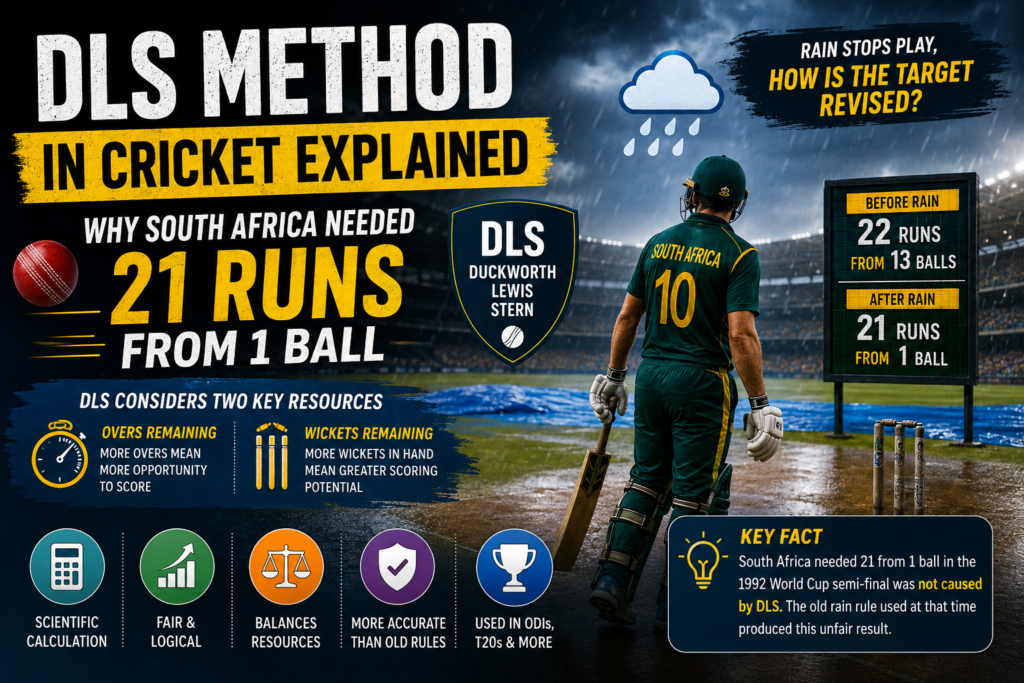
DLS Method in Cricket Explained: Why South Africa Needed 21 Runs From 1 Ball
The Duckworth-Lewis-Stern method is cricket’s best-known system for revising targets when rain interrupts a limited-overs match. But one of the biggest misconceptions in cricket is that DLS caused South Africa’s infamous requirement of 21 runs from 1 ball in the 1992 World Cup semi-final. It did not.
Why I Became Interested in This Topic
My interest in the DLS method started with the 1992 World Cup semi-final between South Africa and England.
For a long time, I had a simple impression of what happened: South Africa needed 22 runs from 13 balls, rain interrupted the match, and suddenly the requirement became 21 runs from just 1 ball. Looking at that situation, I felt South Africa had been a victim of the DLS method.
It seemed impossible to call such an outcome fair.
That feeling made me want to understand the system properly. Why should a team lose almost all its remaining deliveries while the target drops by only one run? How could any mathematical method produce 21 runs from a single ball? Was South Africa really eliminated because of DLS?
When I looked deeper into the history, I discovered something important:
South Africa were not victims of the DLS method in 1992, because DLS was not used in that match.
The tournament used an older rain-adjustment system. That discovery is one of the main reasons I wanted to write this article. The 1992 semi-final did not show why DLS was unfair. It showed why cricket needed a better rain rule.
1. What Is the DLS Method?
The Duckworth-Lewis-Stern method, commonly called the DLS method, is a mathematical system used to revise targets in limited-overs cricket when rain or another interruption changes the amount of playing time available.
It is relevant to formats such as One Day Internationals, T20 Internationals and domestic limited-overs competitions, subject to the playing conditions of the tournament.
The central idea is that a batting team has two major scoring resources:
- Overs remaining
- Wickets remaining
A team with 20 overs left and nine wickets in hand has much greater scoring potential than a team with the same 20 overs left but only three wickets in hand.
2. Why Simple Target Reduction Is Unfair
Imagine Team A scores 300 runs in 50 overs. Rain then reduces Team B’s chase to 25 overs.
A simple proportional calculation might say:
25 × 6 = 150 runs
At first glance, a target around 151 may look fair. But strategically, it is not that simple.
Team A had to manage its batting resources across 50 overs. It could not attack every ball from the beginning without risking a collapse.
Team B, knowing it has only 25 overs, can change its entire approach. It can attack earlier, promote power hitters and worry less about preserving wickets for overs that will never be played.
This is the key problem with proportional target reduction:
A fairer system must consider how many scoring resources remain, not only how many overs were removed.
3. The 1992 World Cup Semi-Final
The most famous rain-rule controversy in cricket occurred during the 1992 World Cup semi-final between England and South Africa at the Sydney Cricket Ground.
England made:
252/6 in 45 overs
South Africa remained in the contest during the chase. Late in the match, the requirement stood at:
22 runs from 13 balls
Then rain interrupted play.
When the match resumed, the revised requirement became:
21 runs from 1 ball
The contest was effectively over.
South Africa could not realistically score 21 runs from one legal delivery under normal match conditions. England advanced, while the bizarre revised requirement became one of the most controversial images in World Cup history.
4. Why South Africa Needed 21 From 1 Ball
The old rain rule used in the tournament is commonly associated with the Most Productive Overs method.
The basic problem was that when overs were removed from the chasing team’s innings, the target adjustment was linked to low-scoring overs from the first innings.
In theory, this was a defined method. In practice, it could produce deeply distorted outcomes.
In the 1992 semi-final, South Africa lost almost all of the deliveries it had remaining, but the target fell by only one run.
After rain: 21 needed from 1 ball
That is why the result looked so absurd. South Africa lost 12 deliveries of opportunity, yet received only a one-run reduction in the requirement.
The old system did not adequately value the match resources being taken away from the chasing team.
5. How the Controversy Influenced Cricket
The 1992 semi-final did not instantly create the Duckworth-Lewis method. It is important not to oversimplify the history.
However, the match became an unforgettable demonstration of why cricket needed a better way to handle interruptions.
The controversy exposed a fundamental weakness in old rain rules: removing overs from a chase is not merely a scheduling adjustment. It removes scoring opportunities and changes batting strategy.
A more rational system needed to account for:
- overs remaining
- wickets remaining
- scoring potential
- timing of the interruption
- resources lost by each side
The 1992 finish became a lasting symbol of the need for reform.
6. Who Invented Duckworth-Lewis?
The original Duckworth-Lewis method was developed by English statisticians Frank Duckworth and Tony Lewis.
Their major conceptual breakthrough was to stop treating rain interruptions as a problem of overs alone.
Instead, they focused on the proportion of batting resources available to a team.
That resource-based approach was much closer to the strategic reality of cricket.
7. How the DLS Method Works
At a simplified level, DLS evaluates the batting resources available before and after an interruption.
Resource 1: Overs Remaining
More overs mean more legal deliveries and therefore more opportunity to score.
Resource 2: Wickets Remaining
More wickets in hand allow a batting team to take greater risks.
Consider these two situations:
- 10 overs remaining with 9 wickets in hand
- 10 overs remaining with 2 wickets in hand
The number of balls remaining is identical, but the realistic scoring potential is not.
DLS uses a resource model to estimate these differences and revise the target accordingly.
8. Simple DLS Example
Consider a simplified hypothetical match.
Team A scores:
250/8 in 50 overs
Team B begins chasing 251 and reaches:
150/3 after 30 overs
Then heavy rain prevents the full chase from being completed.
A crude method might simply reduce the target according to the number of overs lost.
DLS instead asks a more meaningful question:
Team B had seven wickets in hand. That means it still possessed significant potential for acceleration.
The revised target therefore depends on the resource situation, not just the number of overs removed.
This example is intentionally simplified. An exact official target requires the applicable DLS calculation rather than basic arithmetic alone.
9. Why Wickets Matter
Wickets are central to understanding DLS.
Imagine two teams after 15 overs of a T20 innings:
Team Y: 120/8 after 15 overs
Both teams have the same score and the same number of overs remaining.
But Team X has nine wickets in hand. It can attack aggressively in the final five overs.
Team Y has only two wickets remaining. It faces a serious risk of being bowled out.
Therefore, their remaining batting resources are not equal.
This is one of the clearest reasons why a resource-based method is more logical than a simple run-rate calculation.
10. What Is the DLS Par Score?
The DLS par score is the score associated with being level at a particular stage of the chase under the applicable DLS calculation.
It becomes especially important when rain is approaching.
If the chasing team is on 96, it may be ahead of the relevant par position.
If it is on 94, it may be behind.
The precise match result depends on the target, playing conditions and exact DLS calculation.
Why Can the Par Score Change After a Wicket?
Because a wicket reduces the batting resources remaining.
A team may appear comfortably placed before losing a wicket. If rain then ends the match, that wicket can materially change its DLS position.
This is why wickets immediately before a rain stoppage can be decisive.
11. What Does “Stern” Mean in DLS?
The system was originally known as the Duckworth-Lewis method, often shortened to D/L.
Australian statistician Steven Stern later became the custodian of the method and contributed important updates to the model.
The system became known as the:
Duckworth-Lewis-Stern Method
or simply:
DLS
The evolution mattered because limited-overs batting changed significantly over time.
Modern cricket introduced:
- more aggressive power hitting
- deeper batting line-ups
- faster scoring rates
- T20 tactical innovations
- more extreme death-over acceleration
Statistical models therefore needed to reflect modern scoring patterns more effectively.
12. Why Fans Still Criticize DLS
DLS is more sophisticated than older rain rules, but it is not free from criticism.
It Is Difficult to Understand
Most spectators cannot independently calculate an official DLS target during a match.
Target Changes Can Look Strange
Revised targets may appear surprising, especially when a wicket falls shortly before rain.
13. DLS vs Old Rain Rules
The biggest difference between the DLS method and older rain rules is the way they define what a batting team loses when play is interrupted.
Older systems often focused heavily on overs and runs. DLS takes a more strategic view by treating overs remaining and wickets remaining as batting resources.
This distinction matters because two teams can have exactly the same number of overs left but completely different scoring potential.
Team B: 120/8 after 15 overs
Both teams have five overs remaining. Both have scored 120 runs. But their positions are clearly not equal.
Team A has nine wickets in hand and can attack almost every remaining delivery. Team B has only two wickets left and faces the immediate risk of being bowled out.
A rain-adjustment method that looks only at overs would fail to capture this difference.
| Feature | Older Rain Rules | DLS Method |
|---|---|---|
| Overs remaining | Usually considered | Central to the calculation |
| Wickets remaining | Often inadequately represented | Central to resource assessment |
| Batting resources | Limited or crude treatment | Core principle of the model |
| Future scoring potential | Could be badly distorted | Modelled more systematically |
| Modern scoring patterns | Limited adaptation | Model updated over time |
| Tactical realism | Often weak | Generally stronger |
The Core Difference
Older rain rules could effectively ask:
DLS asks a more sophisticated question:
That is a fundamentally different way of analysing the match.
Why the 1992 Rule Failed So Visibly
The 1992 World Cup semi-final is the clearest historical example of the weakness of an older method.
South Africa did not merely lose a few overs somewhere in the middle of an innings. They lost deliveries at the decisive final stage of a World Cup knockout chase.
Before the interruption:
22 needed from 13 balls
After the interruption:
21 needed from 1 ball
South Africa lost 12 deliveries of opportunity, while the requirement fell by only one run.
That outcome demonstrated the weakness of treating rain adjustments without adequately valuing the actual batting opportunity removed from the chasing team.
14. Why DLS Matters in T20 Cricket
DLS is particularly important in T20 cricket because every over represents a large percentage of the innings.
In a 50-over match, losing five overs removes 10% of the scheduled innings.
In a 20-over match, losing five overs removes:
25% of the scheduled innings
That is a major tactical disruption.
A T20 Innings Is Not Scored at One Constant Rate
One of the biggest mistakes in understanding rain-adjusted targets is assuming that every over has equal strategic value.
T20 teams often structure an innings around different phases:
- Powerplay: exploit fielding restrictions
- Middle overs: manage spin and control matchups
- Pre-death phase: prepare for acceleration
- Death overs: maximize boundary scoring
Rain can completely change that structure.
Example: A 20-Over Chase Becomes a 12-Over Chase
Team B: originally expects a full 20-over chase
Rain interruption: chase reduced to 12 overs
A simple proportional approach would fail to account for a major tactical reality.
Team B no longer needs to preserve wickets for overs 13 to 20.
Its entire batting plan can change.
The team may:
- promote its strongest boundary hitters
- attack from the first over
- take greater powerplay risks
- delay or remove the role of an anchor batter
- use finishers much earlier
- accept a higher wicket-loss rate
This is why simply taking 60% of the original target because 12 of 20 overs remain would not automatically produce a fair chase.
Why Wickets Become Even More Important in T20 DLS Situations
Consider two teams when rain arrives after 10 overs:
Team Y: 90/7 after 10 overs
Their scores are identical.
But Team X has enormous remaining hitting potential because nine wickets are still available.
Team Y has only three wickets remaining and is much closer to being bowled out.
Any serious rain-adjustment system must recognize that difference.
Why Captains Watch the DLS Par Score
When rain is approaching, T20 strategy can change ball by ball.
A batting team may be ahead of the relevant DLS position, lose a wicket, and suddenly find itself in a much weaker position because its remaining resources have changed.
This creates a unique tactical problem:
That is why DLS knowledge matters not only to fans and commentators, but also to captains, coaches and analysts.
15. The Legacy of 1992
The 1992 World Cup semi-final between England and South Africa remains one of the most important rain-rule controversies in cricket history.
More than three decades later, the sequence is still remembered:
Rain interruption
21 needed from 1 ball
Few scoreboards have explained a broken system so clearly.
A fan did not need to understand advanced mathematics to see the problem. South Africa had lost almost all of their remaining deliveries, yet their required runs had barely changed.
My Original Misunderstanding
This is also where my own interest in the topic began.
When I first looked at the 1992 incident, I felt South Africa had been a victim of the DLS method.
The situation seemed like obvious evidence against DLS:
How can 22 from 13 become 21 from 1?
But when I looked deeper, I found that my original assumption was wrong.
It did not use the Duckworth-Lewis method.
South Africa were victims of the old rain rule used in that tournament.
That discovery changed the way I understood the entire controversy.
The 1992 match was not evidence that DLS had failed South Africa.
It was evidence of why cricket needed a better rain-adjustment method.
The Bigger Lesson From 1992
The controversy demonstrated that a fair rain rule cannot focus only on the number of overs removed.
It must consider the value of the batting opportunity that disappeared.
Losing 12 balls when a team needs 22 runs is not a minor interruption. Those 12 deliveries are the actual opportunity to complete the chase.
If almost all of those opportunities disappear, a system must account for that loss in a meaningful way.
Why the Match Still Matters Today
Modern cricket is faster than the game played in 1992.
T20 cricket, power hitting, deeper batting orders and aggressive chase strategies have made rain calculations even more important.
A single interruption can now affect:
- powerplay strategy
- bowling matchups
- finisher usage
- wicket preservation
- required run rate
- qualification scenarios
- knockout results
The legacy of 1992 is therefore bigger than one controversial semi-final.
It remains a warning about what happens when a mathematical rule does not adequately reflect the strategic reality of the sport.
16. Frequently Asked Questions
What is the full form of DLS in cricket?
DLS stands for Duckworth-Lewis-Stern. It is a method used to revise targets in interrupted limited-overs cricket matches.
Why is the DLS method used in cricket?
The DLS method is used when rain or another interruption changes the amount of playing time available. Its purpose is to create a revised target by considering the batting resources available to the teams.
Did DLS cause South Africa to need 21 runs from 1 ball in 1992?
No. This is one of the biggest misconceptions about the DLS method. The 1992 World Cup semi-final used an older rain-adjustment rule. DLS did not produce the 21-runs-from-1-ball requirement.
What did South Africa need before the rain interruption in 1992?
South Africa needed 22 runs from 13 balls. After the interruption and recalculation under the old system, the requirement became 21 runs from 1 ball.
Why did South Africa need 21 runs from 1 ball?
The old rain rule used in the tournament adjusted the target in a way that removed almost all of South Africa’s remaining deliveries while reducing the required runs by only one. This produced the infamous 21-from-1-ball situation.
Were South Africa victims of the DLS method?
No. South Africa were victims of the old rain-adjustment system used at the 1992 World Cup. The Duckworth-Lewis method was not the system used in that semi-final.
Who invented the Duckworth-Lewis method?
The original method was developed by English statisticians Frank Duckworth and Tony Lewis.
Why was Stern added to Duckworth-Lewis?
Australian statistician Steven Stern became the custodian of the method and contributed updates to the model. The method became known as the Duckworth-Lewis-Stern method.
Does DLS consider wickets?
Yes. Wickets remaining are central to the DLS resource concept because a team with more wickets in hand generally has greater future scoring potential.
Does DLS consider overs remaining?
Yes. Overs remaining are one of the main dimensions of batting resources considered by the method.
What is a DLS par score?
The DLS par score is the score associated with being level at a particular stage of the chase under the applicable DLS calculation.
Can one wicket change the DLS result?
Yes. A wicket reduces the batting resources remaining. In a close rain-affected match, losing a wicket before play stops can materially change the chasing team’s DLS position.
Why does the DLS par score change after a wicket?
The par position can change because the batting team has fewer wickets available and therefore less remaining scoring resource.
Is DLS used in T20 cricket?
Yes. DLS is widely used in rain-affected T20 matches under the applicable competition playing conditions.
Why is DLS especially important in T20 cricket?
Every lost over represents a significant percentage of a 20-over innings. Rain can also change powerplay strategy, batter roles, wicket preservation and the timing of acceleration.
Is the DLS method completely fair?
No mathematical system can perfectly recreate a match after weather changes the available playing time. However, DLS is generally more sophisticated than older rain rules because it models batting resources through overs and wickets rather than relying only on crude target reduction.
Can fans calculate DLS manually?
Fans can understand the basic resource principle, but exact professional DLS calculations are more complex than a simple run-rate formula. Official match calculations use the applicable DLS system and competition playing conditions.
What is the biggest misconception about DLS?
One of the biggest misconceptions is that DLS caused South Africa’s 21-runs-from-1-ball requirement in 1992. It did not. That incident occurred under the older rain rule used at the tournament.
About the Author
Sudheer Reddy is the founder of CricLogic and an independent cricket analyst passionate about uncovering the logic behind the game. He writes in-depth, evidence-based articles on pitch behaviour, batting and bowling tactics, match strategy, and cricket laws. His goal is to make complex cricket concepts simple, practical, and easy for every fan to understand. Every article is driven by curiosity, research, and a commitment to helping readers see what lies beyond the scoreboard.
