Headingley, Leeds — The Complete Venue Guide

Last updated: 17 July 2026 · Ground guide, part of the CricLogic venue series
Headingley, Leeds — Complete Venue Guide
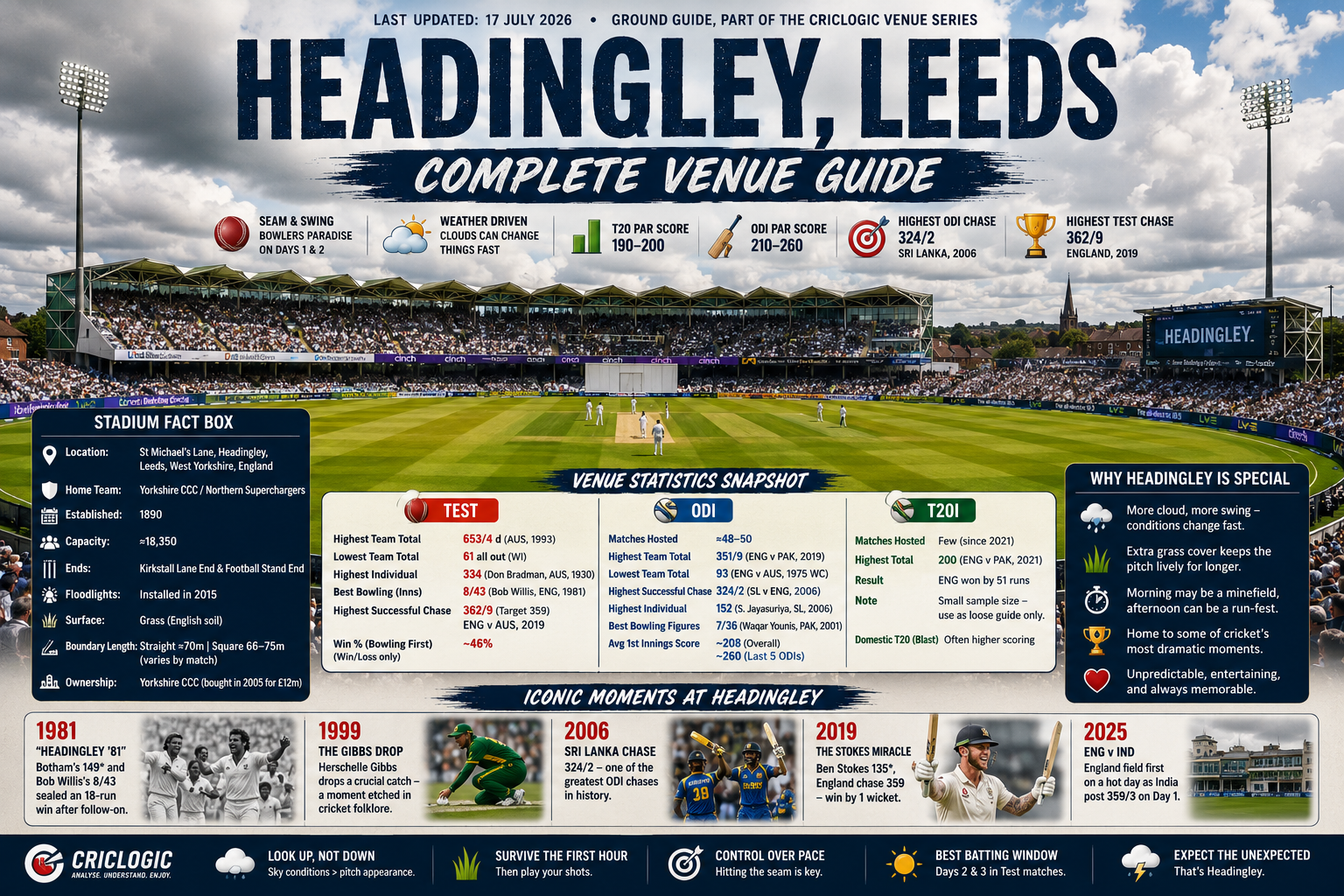
TL;DR — Headingley at a Glance
- Best conditions for: Seam and swing bowlers on days one and two, especially under Leeds’ notorious cloud cover; batters who can survive the first hour tend to cash in later.
- Toss tendency: No settled pattern — the old cliché is “look up, not down” when overcast, but recent England teams have fielded first even in clear conditions, so treat this as situational, not automatic.
- T20 par score: Around 190–200 in the small sample of international T20Is played here; domestic Blast games at the ground have regularly topped that.
- ODI par score: Roughly 210–260 depending on which period of matches is sampled — older data pulls the average down, recent matches pull it up (see the stats table below for why).
- Highest successful chases: 324/2 (Sri Lanka, ODI, 2006) and 362/9 (England, Test, 2019) — both among the more famous chases in the sport’s history.
- Best batting window: Days two and three of a Test, once the new-ball shine has gone and the surface has dried and flattened.
- Biggest risk factor: The weather. Leeds’ cloud and rain can turn a docile morning into a seaming, swinging session within an hour, and has produced some of the most volatile sessions in English cricket.
This box is directional and aggregated from multiple public sources for quick orientation — not a Statsguru-verified dataset. Treat exact averages as approximate; see the stats section for sourcing caveats.
Stadium Fact Box
| Name | Headingley Cricket Ground (currently sponsored as Headingley Stadium’s cricket ground; formerly Headingley Carnegie Stadium, 2006–2017, and Emerald Headingley Stadium, 2017–2021) |
| Location | St Michael’s Lane, Headingley, Leeds, West Yorkshire, England |
| Home team | Yorkshire County Cricket Club; also home ground of the Northern Superchargers in The Hundred |
| Capacity | Approximately 18,350 (some sources list figures between 17,000 and 18,350 depending on the configuration counted) |
| Ends | Kirkstall Lane End and Football Stand End |
| Established | 1890 (first recorded first-class match, 1890) |
| First Test | 29 June–1 July 1899, England v Australia |
| First ODI | 5 September 1973, England v West Indies |
| T20I history | Began hosting T20Is in July 2021 (England v Pakistan); a small handful of internationals since |
| Floodlights | Installed in 2015 |
| Surface | Grass, English soil; unusually for a major ground, Headingley has no permanent pavilion — players use dressing rooms built into the modern stands |
| Boundary length | Not fixed — reported straight boundaries around 70m and square boundaries ranging roughly 66–75m depending on which side and which source; boundaries are reset for every match and can shift year to year |
| Ownership | Yorkshire CCC, which bought the ground outright in 2005 for £12 million |
Stadium Overview
Headingley is one of English cricket’s great oddities: a Test venue with no pavilion, wedged into a stadium complex it shares with the Leeds Rhinos rugby league club, in a residential pocket of suburban Leeds two miles from the city centre. It has hosted international cricket since 1899 and has built a reputation, fairly earned, as the most theatrically unpredictable Test ground in England.
The ground began life as a multi-sport venue developed by a group of Yorkshire benefactors, cricket being just one of six sports it was originally built for alongside rugby, football, tennis, bowls and cycling. Yorkshire CCC used it as an away venue for over a century before finally buying the ground from the city in 2005. Since then it has been steadily rebuilt: almost every stand has gone up since 2000, and floodlights arrived in 2015, turning it into a full day-night venue for white-ball cricket and the Hundred.
What makes Headingley unique isn’t its architecture — it’s its personality. More than almost any other English ground, results here follow the sky. A morning of low cloud can turn a placid pitch into a minefield for batters; by mid-afternoon on the same day, once the sun breaks through and the shine wears off the ball, the same surface can flatten into a run-fest. That volatility, more than any single dimension or statistic, is the defining fact about the ground.
Ground Dimensions and Pitch Construction
Headingley sits on a compact footprint by international standards. Reported boundary lengths vary noticeably by source and by year — largely because ropes are set differently match to match — but the pattern that recurs across reports is a straighter boundary in the high-60s to low-70s metres, with square boundaries ranging from the mid-60s out toward 75 metres on the longer side. That’s on the shorter end for a Test venue, which is part of why the ground can produce both disciplined seam bowling and, once the ball gets old, some eye-catching hitting.
The square itself is prepared on typical English loam, with a heavier grass covering than many subcontinental or Australian venues. Groundstaff have openly discussed leaving extra grass and moisture on the surface in recent years specifically to guard against matches finishing inside three days — a direct response to how quickly the pitch can deteriorate once it dries out.
Venue Statistics
Headingley’s numbers are genuinely contested across public sources, and that disagreement is itself informative — it reflects how much the ground’s identity has shifted between eras (flatter, batting-friendly stretches in the 2010s vs. the more result-oriented, seam-heavy conditions of the past few years). Where sources disagree, both figures are shown.
Test
| Metric | Figure |
|---|---|
| Highest team total | 653/4 declared, Australia v England, 1993 |
| Lowest team total | 61 all out, West Indies v England |
| Highest individual score | 334, Don Bradman (Australia) v England, 1930 — he was dismissed for 334 on the second morning, not left unbeaten, despite what a few aggregator sites claim |
| Best bowling (innings) | 8/43, Bob Willis (England) v Australia, 1981 |
| Highest successful run chase | 362/9 (target 359), England v Australia, 2019 — England’s highest successful Test chase at the time |
| Toss/result pattern | One widely cited figure has teams bowling first winning around 46% of Tests here; positive results (win/loss rather than draw) are unusually common at Headingley compared with most English grounds |
ODI
| Metric | Figure |
|---|---|
| Matches hosted | Approximately 48–50 (sources differ by a couple of matches depending on cutoff date) |
| Highest team total | 351/9, England v Pakistan, 2019 |
| Lowest team total | 93 all out, England v Australia, 1975 World Cup |
| Highest successful chase | 324/2, Sri Lanka v England, 2006 |
| Highest individual score | 152, Sanath Jayasuriya (Sri Lanka) v England, 2006 |
| Best bowling figures | 7/36, Waqar Younis (Pakistan) v England, 2001 |
| Average first-innings score | Cited as roughly 208 across the ground’s full ODI history, but recent matches alone (last five ODIs at the venue) average closer to 260 — a clear sign that scoring has trended upward as bats, boundaries and pitch preparation have all changed since the 1970s and 80s figures were set |
T20I
Headingley’s international T20 sample is small — only a handful of T20Is have been played here, starting in 2021 — so treat any “par score” for the format as a loose guide rather than a settled figure. The one completed T20I on record saw England post 200 and defend it comfortably against Pakistan; Yorkshire’s own Vitality Blast fixtures at the ground, played far more often, have tended to be higher-scoring than that single international data point suggests. Domestic T20 and Hundred data are not folded into the international table above because the conditions (shorter boundaries, different ball, different time of season) aren’t directly comparable.
Climate and Weather Impact
Leeds sits in a part of England that gets more cloud cover and rain interruptions than the southern Test grounds, and the physics behind Headingley’s reputation is real, not folklore. Conventional swing depends on the ball retaining a shiny side and a rough side for as long as possible; damp outfields and cooler, moister air slow down the rate at which the shiny side scuffs, so the ball swings for longer here than it would on a dry, abrasive southern ground. The much-repeated idea that humidity itself makes the ball swing more is a myth in the strict physics sense — what humidity actually does is correlate with the cloudy, still conditions that preserve the shine and reduce the small air-density effects that can otherwise dampen swing. Wind matters too: a breeze angled across the pitch toward the stands can exaggerate lateral movement, while a headwind for the bowler tends to flatten it out. As the day dries and the outfield firms up, the ball scuffs faster, conventional swing fades, and old-ball reverse swing or straightforward seam movement off a wearing pitch takes over instead.
Pitch Science
Curators at Headingley have talked openly about grass cover as a deliberate lever: more grass retains moisture for longer and keeps the surface lively into day two or three, which both helps seamers and reduces the risk of a match finishing early. As that grass is mown down and the surface dries across a multi-day match, the pitch typically firms up, true bounce becomes more reliable for stroke-play, and by days four and five cracks can open, bringing variable bounce and some turn into play. That late-match unpredictability is a genuine feature of the ground, not an exaggeration — several of Headingley’s most famous results have hinged on exactly that shift from bowler-friendly new-ball conditions to a flatter middle period to a scratchy final day.
How the Pitch Plays — By Phase and Format
New ball
This is Headingley’s signature phase. Under any cloud at all, seam and swing bowlers get consistent purchase, and even in sunshine there’s usually enough grass and pace in the pitch for the new ball to do something. Sides that survive the first 10–15 overs of a Test morning, or the powerplay in white-ball cricket, tend to find things get markedly easier.
Old ball / middle overs
Once the shine goes, the pitch tends to flatten and true bounce takes over — historically Headingley’s best stretch for batting, particularly on days two and three of a Test.
Under lights
Floodlit sessions (from 2015 onward) bring cooler, damper evening air, which can revive some of the new-ball swing effect even later in an innings — a factor white-ball captains weigh when deciding whether to bat or field first in day-night fixtures.
Late in a multi-day match
By day four or five, cracks and footmarks can bring in variable bounce and slow bowling assistance, and reverse swing becomes a live threat with an old, rough ball — the phase that has produced some of the ground’s most dramatic finishes.
The CricLogic Reading Framework for Headingley
Swing likelihood guide
- Cloud cover at the toss and forecast to persist through the first session — high likelihood of prolonged conventional swing
- Clear skies with a firm, dry outfield — swing likely to be brief, concentrated in the first few overs before the shine goes
- Steady breeze across the ground rather than straight down the pitch — tends to amplify lateral movement
- Old ball, rough one side, reverse-swing conditions more likely once the pitch has dried out and the outfield has scuffed the ball
Seam assessment checklist
- How much grass has been left on the surface — more grass generally means more seam movement, especially early
- Recent rainfall and how much the groundstaff have watered the pitch in preparation
- Day of the match — seam tends to be most pronounced on day one, most negotiable on days two and three
- Bowler’s ability to hit the seam consistently rather than search for outright pace — this ground rewards control over raw speed
Chase comfort factors
- Format matters enormously — ODI chases here have a long history of success (Sri Lanka’s 324 in 2006 among them), while Test chases are historically much harder given how the pitch wears
- Weather forecast for the chasing innings — a clearing sky generally favours the side batting second
- Dew is a minor factor compared with subcontinental venues, but a damp evening can still ease scoring slightly under lights
- How the surface has behaved earlier in the same match — if seamers have dominated all game, chasing sides should expect no let-up
Risk meter
Headingley sits toward the higher-risk end of English venues for both formats: results here are more common than draws in Tests, totals swing widely match to match, and the weather adds a layer of unpredictability that flatter, more climate-stable grounds don’t carry. Teams and fantasy/analysis approaches that assume a “typical” par score at Headingley are working against the ground’s own history — the range of outcomes here is wider than most.
Captain’s Decision Tree
Won the toss, overcast skies forecast to persist: Bowling first is the traditional call — exploit the cloud while it lasts, aim to have the opposition in trouble inside the first hour.
Won the toss, clear skies and a dry pitch: Historically this favoured batting first, but recent England teams under Ben Stokes have shown a marked preference for fielding first regardless of conditions — a reminder that team philosophy, not just the pitch, now shapes the toss call here as much as anywhere in world cricket.
Test match, days four and five: Expect variable bounce and possible turn; sides batting last should plan for a harder, scratchier surface than earlier in the game.
White-ball, day-night fixture: Weigh the cooler evening air against the general historical tilt toward totals being gettable in the chase — conditions can still turn sharply if cloud rolls in during the evening session.
Toss Impact and Match Strategy
Headingley has one of the more debated toss reputations in English cricket. The old cliché — “look up, not down” when deciding what to do — reflects decades of experience that the sky, not the surface, is what should drive the decision. But that guidance has been complicated recently: sources tracking Test results here note bowling-first sides winning close to half their matches, while England’s own recent captains have fielded first even under hot, dry skies that traditionalists like Michael Vaughan have publicly argued should have meant batting. The honest read is that Headingley no longer has one dominant “correct” toss call — it has a set of competing signals (cloud, recent rainfall, team philosophy, personnel) that captains now have to weigh against each other rather than following a single rule of thumb.
Notable Matches
1930 — Bradman’s 334
Don Bradman scored 309 runs in a single day on his way to 334, dismissed early on day two, in what remains one of the most famous individual innings in Test history. The match itself was drawn.
1981 — “Headingley ’81,” Botham and Willis
England, forced to follow on and staring at Ladbrokes odds of 500–1 against them, were rescued by Ian Botham’s unbeaten 149 and then bowled out Australia for 111 thanks to Bob Willis’s 8/43, winning by 18 runs. It is still routinely ranked among the greatest Test matches ever played, and the match is commonly referred to simply as “Headingley ’81.”
1999 World Cup — the Herschelle Gibbs moment
South Africa’s Herschelle Gibbs dropped a catch against Australia’s Steve Waugh in a decisive Super Six match, a moment that became cricket folklore and is still cited as one of the sport’s most consequential dropped catches.
2019 World Cup group matches
Headingley hosted four fixtures in the 2019 World Cup: England v Sri Lanka, Pakistan v Afghanistan, Afghanistan v West Indies, and Sri Lanka v India.
2019 Ashes — the Stokes miracle
Chasing 359 after being bowled out for 67 in their first innings, England looked finished at 286/9. Ben Stokes then played one of the most celebrated innings in the sport’s history, finishing 135 not out with a last-wicket stand of 76 alongside Jack Leach (1 not out), to win by one wicket and level the Ashes series 1–1. It remains, alongside 1981, the match most associated with the ground.
2025 — England v India
The most recent Test at the venue, played in June 2025, drew scrutiny for England’s decision to field first on a hot, dry day — a call former captain Michael Vaughan publicly questioned — after which India posted 359/3 on the opening day.
Psychology of Batting and Bowling at Headingley
For batters, the mental challenge at Headingley is less about the pitch itself and more about patience under uncertainty: the same morning that looks murderous for batting under cloud can turn benign within an hour, and players who panic or change technique too early tend to come unstuck. For bowlers, the reward structure favours control and seam position over raw pace — the ground has a long history of medium-fast, accurate bowlers outperforming out-and-out quicks, because hitting the seam consistently matters more here than extra speed. The ground’s habit of producing dramatic, close finishes (1981, 2019) has also given it a psychological weight of its own: players and crowds alike now half-expect twists, which can itself affect how tightly a chasing side or a batting side under pressure plays the closing stages.
Coaching View
For batters
Survive the first hour before adjusting your risk profile. Play straighter than usual early on given the lateral movement on offer, and look to cash in once the shine goes and the bounce becomes predictable, typically from the second session onward.
For fast bowlers
Prioritise a consistent seam position and full length over chasing extra pace. The conditions reward bowlers who can hit the top of off stump repeatedly rather than those searching for x-factor speed; reverse swing becomes a genuine weapon with an older ball once the pitch has dried out.
For spinners
Patience is essential — Headingley is rarely a spinner’s pitch in the first two or three days. The opportunity tends to arrive late, on days four and five of a Test, once footmarks and drier soil start to offer grip and occasional turn.
Myth vs Reality
| Myth | Reality |
|---|---|
| “Humidity makes the ball swing more.” | Humidity itself isn’t the mechanism — it correlates with the cloudy, still conditions that keep the ball’s shine intact for longer, which is what actually sustains swing. |
| “Headingley is always a bowling paradise.” | It’s conditional, not constant — once the new-ball shine goes and the sun is out, the same pitch has produced some very high totals (653/4, 351/9). |
| “Winning the toss and bowling first is always correct here.” | Historical toss data is close to a coin flip in Tests, and recent England decisions to field first in dry, hot conditions have been criticised by former players who see batting first as the traditional percentage play in clear weather. |
| “Bradman’s 334 at Headingley was unbeaten.” | He was dismissed on the second morning, having reached 309 not out only at the close of day one. |
| “Headingley has hosted lots of T20Is, so there’s a reliable T20 par score.” | The ground has hosted only a handful of international T20Is; any T20I par figure should be treated as a loose estimate, not a settled statistic. |
Glossary
Conventional swing — sideways movement of a relatively new ball through the air, driven by the contrast between its shiny and rough sides.
Reverse swing — swing in the opposite direction to conventional swing, achieved with an old, roughened ball, usually at higher pace.
Seam movement — deviation off the pitch caused by the ball’s raised seam catching the surface, distinct from swing (which happens in the air).
Follow-on — in a Test match, when the side batting second is forced to bat again immediately after failing to reach within a set margin of the first side’s total.
Par score — the total considered a roughly even contest at a given ground and format, based on historical scoring patterns.
Footmarks — rough patches on the pitch created by bowlers’ run-ups and follow-throughs over a match, which can assist spin bowling later in a game.
Frequently Asked Questions
Is Headingley a good ground to bat first at?
It depends heavily on the sky rather than the calendar. In dry, clear conditions batting first has traditionally been favoured, but under cloud cover — common in Leeds — bowling first to exploit early swing and seam is the more established percentage play.
What is a good total to defend at Headingley?
There’s no single fixed number given the ground’s format history and volatility, but in ODIs a first-innings score in the 260–280 range has generally been competitive in recent matches, while historically even scores in the low 200s have been defendable when conditions favoured bowlers.
Why does Headingley have no pavilion?
Unlike most major English grounds, Headingley never built a traditional pavilion; players use modern dressing rooms built into the stands instead, a quirk that sets it apart from venues like Lord’s or The Oval.
What is the highest score ever made at Headingley?
Australia’s 653/4 declared against England in 1993 is the highest team total recorded at the ground, and Don Bradman’s 334 in 1930 remains the highest individual Test score there.
Why is Headingley considered unlucky or unpredictable for batting first?
Several high-profile Tests here have seen sides bowled out cheaply after batting first, including Australia in 2019 and England on multiple occasions, feeding a reputation that isn’t fully backed by the overall toss statistics but persists because of how dramatic those specific results were.
Has Headingley hosted a Cricket World Cup final?
No. It has hosted group-stage World Cup matches on several occasions, including four fixtures in the 2019 tournament, but the finals in both 1999 and 2019 were played at Lord’s.
Does Headingley favour pace bowling or spin?
Pace and seam bowling dominate the ground’s wicket-taking history, particularly early in matches; spin tends to become relevant only later in multi-day games once the pitch has dried out and worn.
What is the “Miracle of Headingley”?
The term is most associated with two matches: England’s 18-run win over Australia in 1981 after following on (built on Ian Botham’s 149 not out and Bob Willis’s 8/43), and Ben Stokes’s unbeaten 135 that sealed a one-wicket win over Australia in 2019.
Does dew affect play at Headingley?
Dew is a much smaller factor here than at many subcontinental venues, though floodlit evening sessions can bring cooler, slightly damper air that marginally helps the ball skid on and eases stroke-play late in white-ball games.
Who holds the bowling record at Headingley?
Bob Willis’s 8/43 against Australia in 1981 is the best Test bowling figures at the ground; Waqar Younis’s 7/36 for Pakistan in 2001 is the best in ODIs.
Is Headingley a big or small ground?
By international standards it’s on the compact side, with reported boundaries in roughly the high-60s to mid-70s metres depending on direction and match, though exact rope positions vary from game to game.
Related Reading
How This Guide Was Researched
This guide was compiled from publicly available sources including ESPNcricinfo records pages, Wikipedia’s ground and stadium entries, official Yorkshire CCC and ICC releases, and contemporaneous cricket journalism covering the ground’s major matches. Where sources gave conflicting figures — which happens often with boundary lengths, capacity, and long-run scoring averages — both figures are shown rather than one being silently chosen. Where reliable data wasn’t available for a category, that is stated plainly rather than estimated.
Editorial Standards
CricLogic does not publish invented statistics or manufactured “proprietary index” scores. The frameworks and checklists in this guide are presented as editorial judgment intended to help readers think through conditions, not as precision-scored ratings.
Update History
Published 17 July 2026. This guide will be revisited after major series at the venue to keep statistics and notable-match references current.
Corrections Policy
If you spot an error or an updated statistic, please get in touch via the CricLogic contact page and it will be corrected with a visible update note.
