Edgbaston Birmingham Pitch Report, Records & Cricket Stadium Guide (2026)
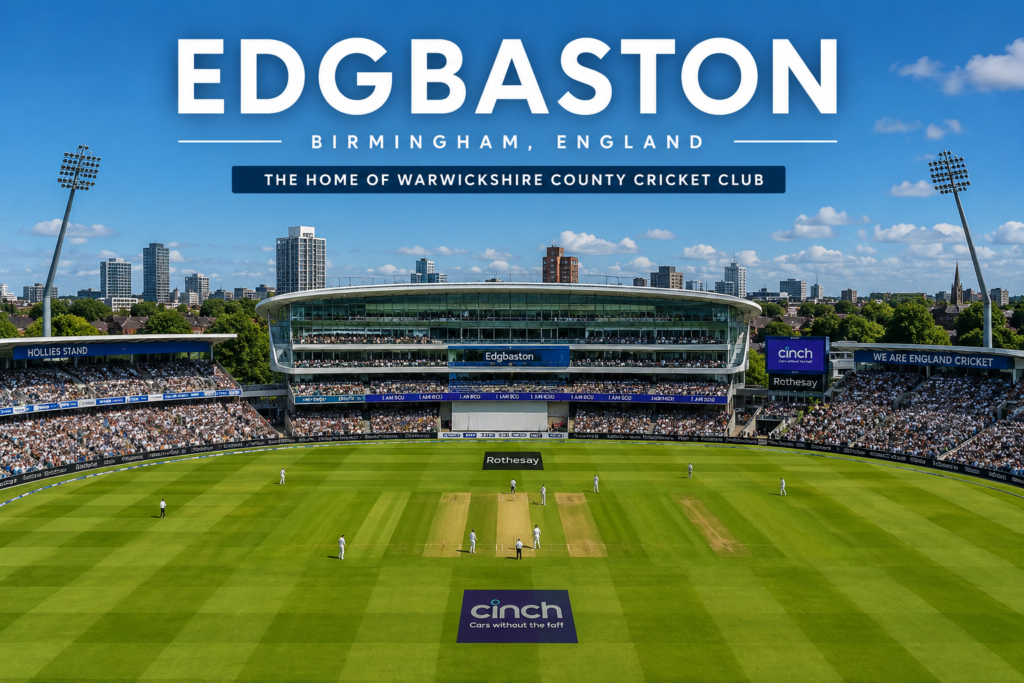
CricLogic · Venue Guide
Edgbaston, Birmingham: Complete Cricket Stadium Guide, Pitch Report & Tactical Analysis
Everything worth knowing about England’s loudest home ground — history, pitch behaviour, weather, records, and how to actually use that information.
TL;DR — Edgbaston at a Glance
- Best for: Fast bowlers who can find pace and carry with the new ball; batters who can survive the first hour and then cash in as the surface true-s up
- Toss tendency: No overwhelming historical bias — captains have both bowled and batted first successfully depending on cloud cover and grass left on the pitch
- ODI scoring: Capable of very high totals — England’s world-record (at the time) 408/9 against New Zealand was made here in 2015
- T20 finals day: Hosted more domestic T20 Finals Days than any other English ground, and boundary hitting is a major feature on the day
- Highest recorded Test score at the ground: 710/7 dec, England v India, 2011
- Notable low score: Australia bowled out for 36 in the ground’s first-ever Test, 1902 — still Australia’s lowest Test total in history
- Biggest risk factor: Early new-ball seam and swing, especially under Birmingham’s changeable cloud cover; and, separately, a crowd loud enough to be a genuine factor for touring sides
These figures combine ESPNcricinfo’s ground records with aggregated third-party match trackers. Where sources disagreed on a number — ground capacity in particular — we’ve flagged the range rather than picking one arbitrarily. Treat this box as directional and verify anything time-sensitive before quoting it.
Stadium Fact Box
| Full name | Edgbaston Cricket Ground (also known as Edgbaston Stadium or the County Ground) |
|---|---|
| Location | Edgbaston, Birmingham, England |
| Home team | Warwickshire County Cricket Club (formed 1882, based at Edgbaston since 1885) |
| Capacity | Commonly cited as around 24,800–25,000 following the 2010–11 redevelopment; older sources cite lower figures (17,500–21,000) reflecting the ground before that rebuild — see note below |
| Ends | Pavilion End, Birmingham End (formerly known as the City End) |
| First international | 1902 — the opening Test of that year’s Ashes series, England v Australia |
| First Test | 1902 |
| Floodlights | Yes — installed in 2011; Edgbaston staged English cricket’s first competitive floodlit match back in July 1997 and England’s first home day/night Test in August 2017 |
| Surface | Grass, English pitch generally rated as offering a fair, pace-and-bounce contest between bat and ball |
| Boundary length | Not reliably published as a single fixed figure across sources; varies by match, as at most English grounds — we’re not going to invent a number here |
Capacity conflict, flagged: the ground held roughly 17,500 before a 1989 expansion, and older 21,000-ish figures still circulate on some venue pages. The £32 million redevelopment completed in 2011 lifted capacity to approximately 24,800–25,000, which is the figure most current sources cite and the one we’d treat as reliable today. Check edgbaston.com for the current official number before publishing anything that depends on it.
Stadium Overview
Warwickshire County Cricket Club was formed in April 1882 and moved into Edgbaston in 1885, playing their first match there — against the MCC — on 7 June 1886. What started as, in the club’s own words, “a meadow of rough grazing land” on the banks of the River Rea has grown into the fourth-largest cricket venue in England, behind Lord’s, Old Trafford and the Oval, and arguably the most intimidating ground in the country for a touring side to bat in.
Edgbaston’s reputation rests less on Victorian pageantry — it was, after all, the youngest of England’s regular Test grounds until Chester-le-Street arrived in 2003 — and more on atmosphere and drama. Stuart Broad once compared it to Australia’s Gabba for the way the crowd gets behind the home side, and results back him up: England’s Test record at Edgbaston is better than at any other home ground.
A Short History
- 1882 – Warwickshire County Cricket Club is formed.
- 1886 – Edgbaston hosts its first match, against the MCC.
- 1902 – Edgbaston stages its first Test, the opening match of that year’s Ashes, in which Australia are bowled out for 36 by Wilfred Rhodes — still Australia’s lowest Test total in history.
- 1994 – Brian Lara scores 501 not out for Warwickshire against Durham, still the highest individual score in first-class cricket.
- 1997 – The first competitive floodlit cricket match in Britain is played at Edgbaston.
- 1999 – Hosts the legendary tied World Cup semi-final between Australia and South Africa, decided by Allan Donald’s last-ball run-out.
- 2005 – England beat Australia by two runs in the second Ashes Test, widely regarded as one of the greatest Test matches ever played.
- 2010–2011 – A £32 million redevelopment of the Pavilion End lifts capacity to roughly 24,800–25,000.
- 2011 – England make 710/7 declared against India, the highest Test total recorded at the ground.
- 2013 – Hosts the ICC Champions Trophy final.
- 2015 – England post 408/9 against New Zealand, an ODI world record at the time.
- 2017 – Hosts England’s first home day/night Test, against West Indies, with the pink ball.
- 2019 – Stages the Cricket World Cup semi-final between Australia and England.
- 2022 – Hosts the first women’s cricket tournament at the Commonwealth Games.
Why Edgbaston Is Unique
Two things separate Edgbaston from England’s other major venues. First, the atmosphere: the Eric Hollies Stand in particular has a reputation for fancy dress and noise that visiting players regularly describe as the most hostile in English cricket. Second, the balance of the pitch itself — it tends to reward genuine pace and carry rather than extravagant swing or prodigious spin, which is part of why the ground has produced both some of Test cricket’s highest totals and some of its most famous batting collapses, often in the same match.
Ground Dimensions and Pitch Construction
Edgbaston sits on a compact, largely rectangular footprint by the River Rea, giving it a more enclosed, amphitheatre-like feel than open, traditional grounds like the Oval. Reported boundary lengths are not consistently published across sources, and — as with most English venues — they shift from match to match depending on exactly where the square is cut, so this guide isn’t going to present a single figure as fixed. Groundstaff prepare a standard English grass pitch; specific clay-content data for the square isn’t reliably published, and rather than invent a number, it’s worth noting only that the surface is generally regarded as a fair, well-balanced Test pitch rather than an extreme one in either direction.
Venue Statistics
The figures below combine ESPNcricinfo’s ground records with aggregated third-party trackers. Treat them as a historical snapshot rather than a live, continuously updated feed, and re-check Statsguru before quoting anything time-sensitive.
Test Snapshot
| Metric | Figure |
|---|---|
| Highest team total | 710/7 dec — England v India, 2011 |
| Notable low total | 36 all out — Australia v England, 1902 (Australia’s lowest-ever Test score) |
| Notable low total (opposition) | 30 all out — South Africa v England, 1924 (South Africa’s lowest-ever Test score) |
ODI Snapshot
| Metric | Figure |
|---|---|
| Highest team total | 408/9 — England v New Zealand, 9 June 2015 (an ODI world record at the time) |
| Lowest team total | 70 — Australia v England, 4 June 1977 |
| Notable result | Australia tied with South Africa, 1999 World Cup semi-final — arguably the most famous ODI ever played |
T20 / Domestic Snapshot
Edgbaston has hosted the T20 Blast’s domestic Finals Day more than any other English ground, which has made it the venue for some of the format’s biggest individual and team scores domestically — including Brendon McCullum’s 158* for Birmingham Bears against Derbyshire in 2015, still one of the highest individual scores recorded in T20 cricket anywhere. Reliable, continuously updated men’s T20I-specific records for the ground weren’t available from the sources used for this guide; check ESPNcricinfo’s ground page directly for a current T20I breakdown.
Climate and Weather Impact
Birmingham sits inland, in England’s West Midlands, which gives Edgbaston a slightly more continental, changeable climate than coastal or riverside grounds like the Oval or Cardiff — warmer highs in a good summer, but also a real chance of sudden cloud and rain moving through quickly given the city’s central location. Early-season fixtures (May–June) in particular can bring cooler mornings and more cloud cover than the height of summer.
The Actual Science, Not Just “Cloud Helps Swing”
- Conventional swing occurs because a new ball has one shiny side and one rough side; air separates from the rough side earlier, pushing the ball toward that side as it travels. Cloud cover doesn’t directly cause this — overcast, humid mornings correlate with cooler, denser air and a softer outfield, both of which help the shine differential survive longer.
- The humidity myth: the idea that “heavier, moist air makes the ball swing more” is a weak explanation on its own. What humidity actually does at a ground like Edgbaston is correlate with cloud cover and a damper morning square — indirect effects that add up to more assistance for seamers, rather than humidity itself being the direct mechanism.
- Air density is the more direct factor: cooler, denser air offers more resistance for the ball to push against, modestly increasing both swing and seam deviation — relevant on a cool Birmingham morning in particular.
- Wind through Edgbaston’s more enclosed bowl shape can behave differently from an open ground like the Oval, occasionally funnelling in ways that favour one end, though this isn’t something this guide can quantify reliably match to match.
- Evaporation and surface drying: as the day warms and overnight moisture evaporates from the pitch, the surface hardens and speeds up — the practical reason batting conditions generally ease as a day’s play progresses.
Pitch Science
- Grass cover: more grass at the toss means more seam movement, since the ball catches individual blades and deviates off the surface.
- Rolling: a heavy roll compacts the surface and tends to reduce movement; a lighter roll leaves more give for seam to bite into.
- Pace and carry: Edgbaston’s square has a long-standing reputation for genuine pace and bounce rather than low, skiddy carry, which is part of why fast bowlers with hit-the-deck pace have historically done well here.
- Wear across a multi-day Test: footmarks and surface breakdown around good-length areas can open rough patches that offer more to finger spin by days four and five than the same pitch showed on day one.
How the Pitch Actually Plays
- New ball, early overs: seamers get the most from the surface, particularly with any cloud cover or on a cooler morning fixture.
- Once the shine goes: the pitch tends to play true, with good carry rewarding batters who survive the opening exchanges — the platform for many of the ground’s big totals.
- Middle overs (white-ball): the surface can lose a little pace, giving spin and cutters a role even without extravagant turn.
- Under lights: dew becomes relevant in white-ball day-night cricket, generally easing conditions for the side batting second — see CricLogic’s dedicated dew-factor breakdown for the underlying mechanism.
Format-by-Format Reading
Tests: a green Edgbaston morning, especially in an early-season fixture, can be a genuine examination for the top order; the surface then tends to flatten into a fair contest for pace bowlers with carry rather than spinners, before offering something to finger spin late in a five-day match.
ODIs: historically capable of very high totals in the right conditions — the 2015 world-record 408/9 is the clearest evidence — though, as the 1977 and 1999 scorecards show, the ground has also produced genuinely low-scoring, tense finishes.
T20: a proven big-hitting venue on Finals Day specifically, though the enclosed bowl shape and a vocal crowd add pressure that has occasionally tipped tight games rather than simply inflating totals.
The CricLogic Reading Framework
These are structured mental checklists built from the patterns above — editorial judgment, not a measured or proprietary scoring system.
Swing Likelihood Guide
| Condition | Swing likelihood |
|---|---|
| Overcast, cool, early-season fixture | High |
| Overcast, midsummer, dry | Moderate–high |
| Sunny, humid | Moderate |
| Sunny, dry, well into an innings | Low |
Seam Assessment Checklist
- Grass cover — how much green is visible on the strip at the toss
- Moisture — recent rain or overnight dew, and how much
- Hardness — freshly rolled and firm, or still carrying some give
A surface scoring high on grass and moisture but not heavily rolled is the profile most likely to trouble batters in the first hour at Edgbaston, given the ground’s reputation for genuine pace and carry once the shine has gone.
Chase Comfort Factors (White-Ball Cricket)
- Dew — a factor in day-night fixtures, though less pronounced than at some UK grounds given Birmingham’s inland climate
- Crowd noise — genuinely worth accounting for; a tight chase under a packed, vocal Edgbaston crowd is a different psychological proposition than the same chase elsewhere
- Historical scoring pattern — a ground capable of very large totals, which cuts both ways for a chasing side depending on the target
Risk Meter — What the Conditions Suggest
| If conditions show… | Favoured approach |
|---|---|
| Heavy cloud, green pitch, new ball | Bowl first, attack with the new ball |
| Clear skies, dry, flat toss reading | Bat first, back the surface’s true bounce |
| Middle overs, ball 20+ overs old | Build partnerships; introduce cutters/spin |
| Day-night, dew forecast | Bowl first where the format and rules allow it |
Captain’s Decision Tree
- Is there cloud cover and visible grass at the toss?
Yes → Bowl first; Edgbaston’s biggest tactical lever is genuine early seam and carry.
No → Continue. - Is it an early-season (May/June) fixture?
Yes → Weight slightly toward bowling first; cooler mornings and more cloud are more likely than in high summer.
No → Continue. - Is it a day-night match?
Yes → Lean toward bowling first if dew is forecast.
No → Batting first on a dry, flat-looking surface is a defensible, historically supported choice, particularly in white-ball cricket given the ground’s big-total pedigree.
This is a simplification of a genuine judgment call shaped by personnel, recent form and forecast detail — not a formula to follow blindly.
Toss Impact and Match Strategy
As at the Oval, Edgbaston doesn’t show an overwhelming historical bias toward batting or bowling first across formats — conditions on the specific day matter more than a blanket rule. What does stand out is how often matches here have been decided by fine margins under pressure: the tied 1999 semi-final and the two-run 2005 Ashes Test are the two most famous examples, and both are reminders that Edgbaston tends to punish tactical hesitation. CricLogic’s broader look at why current run rate can be misleading during a chase is worth reading alongside any Edgbaston chase specifically, given how many close finishes this ground has produced.
Notable Matches
- England v Australia (1902) — Edgbaston’s first Test; Australia bowled out for 36, still their lowest Test total ever.
- England v South Africa (1924) — South Africa bowled out for 30, still their lowest Test total ever.
- Warwickshire v Durham (1994) — Brian Lara’s 501 not out, the highest individual score in first-class cricket history.
- Australia v South Africa, World Cup semi-final (1999) — the famous tie, decided by Allan Donald’s run-out off the third-last ball; Australia advanced on Super Six standings.
- England v Australia, 2nd Ashes Test (2005) — England won by two runs in what’s widely regarded as one of the greatest Test matches ever played.
- England v India (2011) — England’s 710/7 declared, the highest Test total recorded at the ground.
- ICC Champions Trophy final (2013) — hosted at Edgbaston.
- England v New Zealand (2015) — England’s 408/9, an ODI world record at the time.
- England v West Indies (2017) — England’s first home day/night Test, with the pink ball.
- Australia v England, World Cup semi-final (2019) — Australia won, en route to the final at Lord’s, which England went on to win.
Individual batting and bowling leaderboards shift with every series. Rather than quote figures that will be stale within a year, check a current leaderboard on ESPNcricinfo’s Edgbaston records page shortly before a match.
The Psychology of Batting and Bowling at Edgbaston
- The crowd is a genuine tactical factor, not just colour. England’s players and opposition captains alike have described Edgbaston’s atmosphere, particularly from the Eric Hollies Stand, as comparable to a football away-day — visiting batters under pressure here are dealing with noise as much as bowling.
- The first hour sets the tone disproportionately. Because the pitch tends to flatten out, a team that survives the new ball with wickets in hand often goes on to post a genuinely large total — which is also why early wickets here can trigger the kind of pressure spiral CricLogic examines in why batting collapses happen in clusters.
- Tight finishes seem to find this ground. Whether that’s genuine venue character or simply a long, memorable history of close matches is hard to prove statistically, but it’s a reasonable reason for touring sides to rate composure highly when picking a squad for Birmingham.
Coaching View
For batters
- Respect the first 8–10 overs specifically, particularly in a cloudy or early-season fixture — Edgbaston’s flat reputation is a second-hour story, not a first-ball one.
- Play with a straight bat against genuine pace and carry rather than assuming low, skiddy bounce.
- Block out crowd noise deliberately in a tight run chase — it’s a documented factor here, not an exaggeration.
For fast bowlers
- A hit-the-deck length that exploits genuine carry tends to work better here than searching purely for lateral swing.
- Keep an attacking field for longer than instinct suggests in the first spell; the data supports the early overs being the best actual opportunity.
- The new ball’s shine differential can hold up well on a cool, overcast Birmingham morning — worth planning around specifically for early-season fixtures.
For spinners
- Patience over penetration for most of a Test — the surface doesn’t turn sharply until it wears.
- In white-ball cricket, containment through pace variation matters as much as turn, particularly in the middle overs once the shine has gone.
- Rough outside off stump becomes a real weapon by days four and five of a Test, as at most English grounds with wear-based turn.
Myth vs Reality
| Myth | Reality |
|---|---|
| Edgbaston is just a flat, high-scoring ground | It’s produced some of Test cricket’s most famous low scores (Australia’s 36 in 1902, South Africa’s 30 in 1924) as well as some of its biggest totals |
| The crowd noise is just atmosphere, not a real factor | Players and captains on both sides have repeatedly cited it as a genuine tactical consideration, particularly in tight run chases |
| Spin never matters at Edgbaston | Rough outside off stump and a slowing pitch give spinners a real role late in Tests, even without prodigious turn |
| Capacity is a fixed, agreed number | Reported figures range from roughly 17,500 (pre-1989) through 21,000–24,803 depending on the source and year, settling at roughly 24,800–25,000 after the 2011 redevelopment |
| It’s always been a major Test venue | Edgbaston hosted just four Tests in its first 27 years and was, until 2003, the youngest of England’s regular Test grounds |
Glossary
- Conventional swing
- Lateral movement of the new ball through the air, caused by the contrast between its shiny and rough sides.
- Seam movement
- Deviation off the pitch caused by the ball’s raised seam catching the surface on landing.
- Carry
- How well the pitch transmits pace to the ball after the bounce — a defining characteristic of the Edgbaston square specifically.
- Hit-the-deck bowling
- A fast-bowling style that relies on extracting bounce and pace off the pitch rather than lateral swing through the air.
- Good length
- The length, adjusted for pace and pitch, that gives a bowler the best combination of movement and difficulty for the batter to commit front or back foot.
- Rough
- Worn patches of pitch, usually outside off or leg stump, created by bowlers’ footmarks over a multi-day match — a target area for finger spin.
- Super Six / net run rate
- The 1999 World Cup group-stage mechanism that decided Australia’s progression to the final ahead of South Africa despite their Edgbaston semi-final ending in a tie. CricLogic explains the modern equivalent, net run rate, in detail here.
- Deck
- Informal term for the pitch itself.
Frequently Asked Questions
- Is Edgbaston a batting or bowling-friendly ground?
- It’s genuinely balanced — real seam and swing early, particularly under cloud cover, followed by a true, paced surface that has produced some of Test cricket’s biggest totals once batters get through the new-ball period.
- Why is Edgbaston’s crowd considered so intimidating?
- A combination of the Eric Hollies Stand’s reputation for fancy dress and noise, the ground’s relatively enclosed, amphitheatre-like shape, and a long history of England’s best home results being achieved there.
- What is the highest team total recorded at the ground?
- 710/7 declared, by England against India in 2011, in Test cricket. In ODIs, England’s 408/9 against New Zealand in 2015 was a world record at the time.
- What is Edgbaston’s most famous match?
- Two matches share that claim: the tied 1999 World Cup semi-final between Australia and South Africa, and England’s two-run win over Australia in the 2005 Ashes.
- How big is Edgbaston’s capacity?
- Most current sources put it at roughly 24,800–25,000, following a £32 million redevelopment completed in 2011. Older figures of 17,500–21,000 reflect the ground before that rebuild.
- What are the ends called at Edgbaston?
- The Pavilion End and the Birmingham End, the latter previously known as the City End.
- Does Edgbaston favour seam or spin bowling?
- Seam and genuine pace early, particularly with cloud cover; spin becomes more relevant later in a Test once the pitch wears and offers rough outside off stump, rather than through prodigious turn from ball one.
- Has Edgbaston hosted ICC finals?
- Yes — the ICC Champions Trophy final in 2013, plus World Cup semi-finals in both 1999 and 2019.
- Is dew a factor in day-night matches at Edgbaston?
- Yes, though generally less pronounced than at some UK grounds given Birmingham’s inland, less humid climate. See CricLogic’s broader explanation of how dew affects bowling and chasing.
- Why does Edgbaston host T20 Finals Day so often?
- It’s a scheduling and hosting decision by the ECB and Warwickshire CCC rather than a pitch-based rule, though the ground’s central location and big-crowd pedigree make it a natural fit for domestic cricket’s showpiece day.
Related Reading
