Why Do Batting Collapses Happen in Cricket? Hidden Logic Behind Wickets in Clusters
Cricket Tactics & Match Analysis
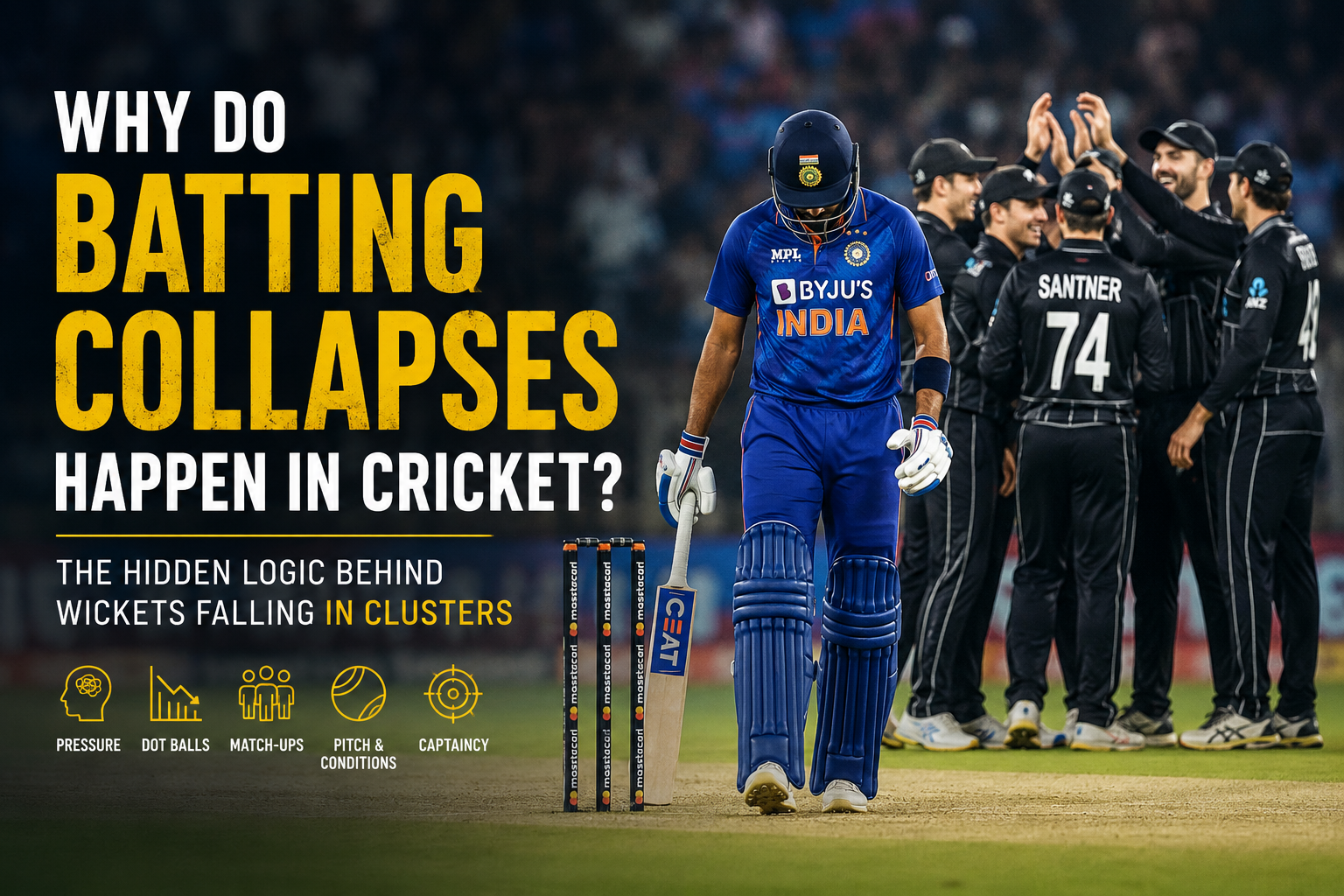
Why Do Batting Collapses Happen in Cricket?
Wickets rarely fall in clusters by accident. Here’s the tactical and psychological chain reaction that turns a comfortable innings into a collapse — and how to spot it before it happens.
A team can look completely in control — set batter timing the ball well, required rate under control — and then lose three or four wickets in the space of a few overs. It happens across formats, from Test cricket to T20s, and it’s one of the most discussed patterns in the sport. This piece breaks down the actual mechanics behind it: why one dismissal raises the odds of another, which phases of an innings carry the most risk, and how commentators, coaches and analysts identify a collapse forming before the scoreboard confirms it.
What Actually Counts as a Batting Collapse?
There’s no official threshold — cricket’s laws don’t define a “collapse.” Losing three lower-order wickets in the final over of a T20 innings, after the score is already competitive, barely counts. Losing two set batters and your best all-rounder in the middle overs of a run chase is a different story entirely, even if the raw wicket count is similar.
The better way to define it isn’t by counting wickets — it’s by measuring how much control was lost.
Working definition: a batting collapse is a cluster of dismissals that costs the innings far more than the sum of the individual wickets — in scoring capacity, partnership stability, or win probability.
A single wicket can remove the only recognised batter left, expose a tail-ender to the new ball, or force two new players to rebuild together. The scorecard shows one dismissal; the actual damage is often much larger. That’s the gap analysts are really pointing to when they call something a collapse.
Why Does One Wicket Often Trigger Another?
The core reason wickets cluster together is simple: a dismissal changes the conditions the next batter walks into.
Before getting out, a set batter has usually spent 20–40 balls reading the pitch — how much it’s gripping, whether the odd ball is skidding on, which bowler is safe to rotate strike against, where the easy singles are. All of that knowledge leaves with them. The incoming batter starts from zero, often against a bowler who now has momentum and a captain who has just gone on the attack.
Captains Turn Aggressive Immediately After a Wicket
Field placements tighten. A team’s strike bowler often comes straight back on. Slips and close catchers return. The easy singles that were available a minute earlier disappear, and the fielding side gets audibly louder — which adds psychological pressure on top of the tactical squeeze.
What analysts watch: the 6–18 balls immediately following a wicket. That short window — not the dismissal itself — usually decides whether an innings stabilises or slides into a genuine collapse.
The New-Batter Vulnerability Window
Even elite batters need time to calibrate to pace, bounce, seam movement and field settings — there’s no shortcut around it. On a slow pitch, a new batter may commit to shots too early. On a quick one, they can be late on length. Against sharp spin or cutters, misjudging length by even a fraction leads directly to lbws and mistimed drives.
This “settling-in” period is exactly when new batters are statistically most likely to get out, which is why bowling sides so often target the player at the non-striker’s end rather than the set batter.
How Dot-Ball Pressure Builds Into a Collapse
A string of dot balls doesn’t just stall the scoreboard — it changes decision-making. As dot balls accumulate, the required rate creeps up, batters start pre-planning risky shots instead of playing what’s bowled, and bowlers gain confidence to attack the stumps rather than bowl defensively.
This is where collapses often accelerate: a batter under self-imposed pressure to “get it going again” plays a shot the situation didn’t actually demand, and the next wicket falls.
Pitch Deterioration and Session Effects
In longer formats especially, the surface itself changes throughout a day or match. Cracks widen, rough patches develop outside the footmarks, and the pitch can grip more for spinners in the third and fourth innings than it did on day one. A partnership that looked secure at lunch can unravel in the final session simply because the pitch is playing differently — nothing to do with batting technique breaking down.
Why Middle Overs Are Prime Collapse Territory in White-Ball Cricket
In ODIs and T20s, the middle overs (roughly overs 7–15 in a T20, or 15–35 in an ODI) sit between the powerplay fielding restrictions and the late-innings slog. Boundaries are harder to find, spinners are introduced, and batting sides are forced to manufacture risk to keep the rate up. This combination — fewer easy boundary options plus rising required rate — is why so many collapses in limited-overs cricket start in this phase rather than at the death.
Bowling Matchups and Captaincy Triggers
Good captains don’t bowl reactively — they plan matchups in advance. A left-arm spinner held back specifically for a batter who struggles against that angle, or a short-ball barrage against someone with a known discomfort against pace, can be introduced the moment a set batter is dismissed. The new batter faces a bowler chosen specifically to exploit them, at the exact moment they’re least equipped to counter it.
Weak Batting Depth as a Multiplier
Teams with a shallow batting order are far more exposed to collapses because there’s less margin for error once the recognised batters are gone. A top-order failure that a deep batting lineup can absorb becomes catastrophic for a side whose numbers 7–9 aren’t equipped to build an innings. This is one reason modern teams increasingly value all-rounders who can bat at 6 or 7 — they extend the point at which a few early wickets stop being fatal.
Two Real Match Patterns
A common Test-match pattern: a side reaches a comfortable position — say 3 wickets down with a settled middle-order pair — only for the second new ball or a spell of reverse swing to remove the set batter. The next two wickets often fall within a handful of overs, as incoming batters face a bowler on a hot streak with an aggressive field already set.
In a run chase, a side can look on course at the halfway mark, only for a single wicket in the 12th or 13th over to trigger a spiral: the new batter takes time to settle, the required rate climbs from under a run a ball to nearly two, and the pressure to accelerate produces a second and third dismissal in quick succession.
How to Spot Collapse Risk Before It Fully Develops
- Check the batting depth remaining — how many recognised batters are left, not just how many wickets are down.
- Watch the 6–18 balls after any wicket — this window shows whether the new batter is settling or struggling.
- Track dot-ball percentage, not just the run rate — rising dot balls usually precede a forced shot.
- Note captaincy changes — a sudden field or bowling change signals the fielding side sees an opening.
- Factor in conditions — deteriorating pitch, overhead conditions, or a new ball due can all raise risk independent of batting quality.
Frequently Asked Questions
Is a batting collapse always a sign of poor technique?
Not necessarily. Conditions, bowling matchups, required-rate pressure and shallow batting depth can all trigger a collapse independent of individual technical failure — though technique against specific threats (short balls, sharp spin) does play a role in who gets targeted.
How many wickets need to fall for it to be called a collapse?
There’s no fixed number. Analysts generally look at how much win probability or partnership stability was lost relative to the number of wickets, rather than applying a strict count.
Why do captains bowl their best bowler right after a wicket falls?
New batters are at their most vulnerable in the first several balls they face, so introducing the most threatening bowler or a favourable matchup at that exact moment maximises the chance of a follow-up dismissal.
Do collapses happen more often in T20 cricket or Test cricket?
They occur in both, but the causes differ — T20 collapses are usually driven by required-rate pressure and forced shot selection, while Test-match collapses are more often tied to pitch deterioration, reverse swing, or a second new ball.
The Takeaway
A batting collapse rarely comes out of nowhere. It’s the product of a chain reaction — a set batter’s dismissal removing accumulated pitch knowledge, an aggressive captaincy response, a new batter’s settling-in vulnerability, and rising pressure from dot balls — that compounds faster than the scoreboard makes obvious. Watching for these signals in real time is what separates reading a collapse after it happens from seeing it coming.
